Virtual Numbers vs eSIM
If you've been researching modern mobile technology, you've probably encountered two terms that appear more frequently than ever before:
Virtual phone numbers and eSIM.
At first glance, they seem remarkably similar.
Both allow you to use a phone number without swapping physical SIM cards.
Both are associated with modern digital communication.
Both are widely used by businesses, travelers, developers, and online platforms.
Because of these similarities, many people assume they are simply two different names for the same technology.
In reality, they are not.
Although virtual numbers and eSIMs can occasionally be used together, they were designed to solve very different problems.
An eSIM replaces a physical SIM card inside your smartphone.
A virtual phone number replaces the need to manage phone numbers through a specific physical device.
One is primarily a telecommunications technology.
The other is primarily a cloud communication service.
Understanding this distinction is important because choosing the wrong solution often leads to unnecessary costs or disappointment.
Someone looking for international mobile data while traveling has very different requirements from someone who needs to verify hundreds of online accounts.
Likewise, a business managing customer support channels has different priorities from a developer testing authentication systems.
Neither technology is universally better.
Each excels in situations it was specifically designed to address.
This guide explains the differences in clear, practical language.
Rather than focusing on technical specifications alone, we'll examine how each technology works in real-world situations and help you determine which option best supports your goals.
Whether you're an international traveler, an entrepreneur, a software developer, or simply trying to understand modern communication technologies, you'll learn when to choose an eSIM, when to use a virtual phone number, and when combining both solutions produces the best results.
Why People Often Confuse eSIM and Virtual Numbers
The confusion is understandable.
Both technologies appeared around the same period as cloud-based communication became more common.
Both remove some of the limitations associated with traditional SIM cards.
Both can be activated online.
And both are often discussed in articles about mobile communication and digital identity.
For someone unfamiliar with telecommunications infrastructure, the distinction is not immediately obvious.
After all, if both provide access to a phone number, aren't they essentially the same thing?
The answer is no.
The similarity exists mostly at the user interface level.
Behind the scenes, the technologies operate in fundamentally different ways.
What Is an eSIM?
An eSIM, short for embedded SIM, is a digital version of the traditional SIM card found in most mobile phones.
Instead of inserting a removable plastic card into your device, the subscriber information is downloaded directly onto a secure chip built into the smartphone, tablet, smartwatch, or laptop.
The chip itself is permanently installed by the device manufacturer.
Changing your mobile carrier no longer requires replacing physical hardware.
Instead, you activate a carrier profile electronically.
Modern smartphones allow users to store multiple eSIM profiles simultaneously and switch between them when needed.
This makes eSIM particularly attractive for:
international travelers;
remote workers;
business users;
people using multiple carriers;
users who frequently change mobile plans.
Despite its digital nature, an eSIM still functions as a traditional mobile subscription.
Your device connects directly to cellular towers operated by your chosen carrier.
Calls, SMS messages, and mobile data travel through the same telecommunications infrastructure used by physical SIM cards.
The only major difference is that the subscriber information is stored digitally rather than on removable hardware.
What Is a Virtual Phone Number?
A virtual phone number serves a different purpose.
Instead of identifying a physical mobile subscription installed in your smartphone, a virtual number is managed through cloud-based telecommunications infrastructure.
Users access their number through an online platform rather than a dedicated SIM card.
Depending on the provider, a virtual number may support:
SMS verification;
incoming SMS;
voice calls;
business communication;
long-term rentals;
temporary activations.
Many users first encounter virtual numbers while creating accounts on services such as Telegram, WhatsApp, Google, Facebook, TikTok, or Microsoft.
However, verification is only one of many possible applications.
Businesses use virtual numbers to organize customer support.
Developers use them while testing authentication systems.
International companies use them to establish local communication channels.
Unlike eSIM technology, a virtual number does not depend on a specific smartphone.
The number exists independently within cloud infrastructure.
The Fundamental Difference
The simplest way to understand the difference is to ask one question:
Where does the phone number live?
With an eSIM, the mobile subscription is installed inside your device.
Even though no plastic SIM card is required, the phone itself remains the center of the communication process.
With a virtual number, the phone number exists independently in cloud infrastructure.
Messages are received and managed through an online platform instead of being tied to one particular smartphone.
This architectural difference explains why each technology excels in different situations.
Different Problems, Different Solutions
Another useful way to compare these technologies is to think about the problems they solve.
An eSIM is designed to modernize mobile connectivity.
It replaces the traditional SIM card while keeping the overall mobile network experience largely unchanged.
Virtual numbers solve an entirely different challenge.
They simplify the management of phone numbers across online services, businesses, software projects, and international operations.
Rather than replacing physical SIM cards, they reduce the need to depend on them for every digital workflow.
Why Businesses View Them Differently
Businesses rarely evaluate technology based on novelty.
Instead, they ask whether it solves operational problems.
For organizations managing dozens or hundreds of online accounts, replacing physical SIM cards with eSIMs may simplify hardware management.
However, it does not eliminate the challenge of organizing account verification, customer communication, or regional digital identities.
Virtual numbers address these operational needs directly.
This explains why many organizations use both technologies simultaneously rather than treating them as competing alternatives.
A Common Misunderstanding
A common misconception is that purchasing an eSIM automatically provides the same flexibility as using a virtual phone number.
In reality, these technologies operate in different layers of the telecommunications ecosystem.
An eSIM gives your device access to a mobile network.
A virtual number gives you access to a cloud-managed telephone number.
The overlap is much smaller than many users initially expect.
Who Should Read This Guide?
This guide is designed for anyone deciding between these technologies, including:
international travelers;
software developers;
entrepreneurs;
remote teams;
digital marketers;
customer support managers;
online sellers;
privacy-conscious users.
Each group approaches communication differently.
By understanding the strengths and limitations of both technologies, you can choose the solution that best supports your own workflow rather than following general recommendations that may not fit your needs.
What You'll Learn
In the following sections, we'll explore:
how eSIM technology works;
how virtual phone numbers operate;
the technical differences between them;
privacy considerations;
international communication;
business applications;
software development use cases;
SMS verification;
travel scenarios;
situations where combining both technologies makes the most sense.
By the end of this guide, you'll understand not only what separates virtual phone numbers from eSIM technology, but also which solution provides the greatest value for your specific situation.
Key Takeaways
Although virtual phone numbers and eSIM technology are often mentioned together, they serve fundamentally different purposes.
An eSIM modernizes how your device connects to a mobile network by replacing the traditional physical SIM card with a digital profile.
A virtual phone number moves the phone number itself into cloud-based infrastructure, making it easier to manage verification, communication, and digital identities without relying on a specific device.
Understanding this distinction is the foundation for choosing the right technology—and in many cases, recognizing that the best solution is not choosing one over the other, but knowing when to use each.
How eSIM Technology Works
To understand the difference between eSIM and virtual phone numbers, it helps to look at what happens behind the scenes after you activate each technology.
Let's start with eSIM.
An eSIM works almost exactly like a traditional SIM card.
The only difference is that the subscriber identity is stored digitally instead of on a removable plastic card.
When you purchase an eSIM plan, your mobile carrier provides a digital profile.
This profile contains the information needed for your device to identify itself on the mobile network.
Instead of inserting a SIM card, you simply download the profile onto your smartphone.
Once activated, your phone connects directly to nearby cellular towers, just as it would with a physical SIM.
From that point forward, your device communicates with the carrier's network in the usual way.
You can:
make phone calls;
receive calls;
send SMS messages;
receive SMS messages;
access mobile data.
To the mobile network, there is very little difference between an eSIM and a traditional SIM card.
The communication process remains almost identical.
The Device Remains the Center
One important concept helps explain everything else.
With an eSIM, your smartphone remains the center of the communication process.
Every call.
Every SMS.
Every internet session.
Everything passes through your physical device.
Even though the SIM is digital, your phone is still responsible for connecting to the carrier network.
If the phone is turned off, disconnected, or damaged, communication may be interrupted depending on the service being used.
This is exactly how traditional mobile subscriptions have always worked.
How Virtual Phone Numbers Work
Virtual phone numbers follow a very different architecture.
Instead of connecting your smartphone directly to a mobile network, the phone number is managed inside cloud-based telecommunications infrastructure.
When someone sends an SMS to your virtual number, the message does not travel to a physical phone sitting on your desk.
Instead, it reaches infrastructure operated by the virtual number provider.
That infrastructure receives the message and immediately displays it inside your online account.
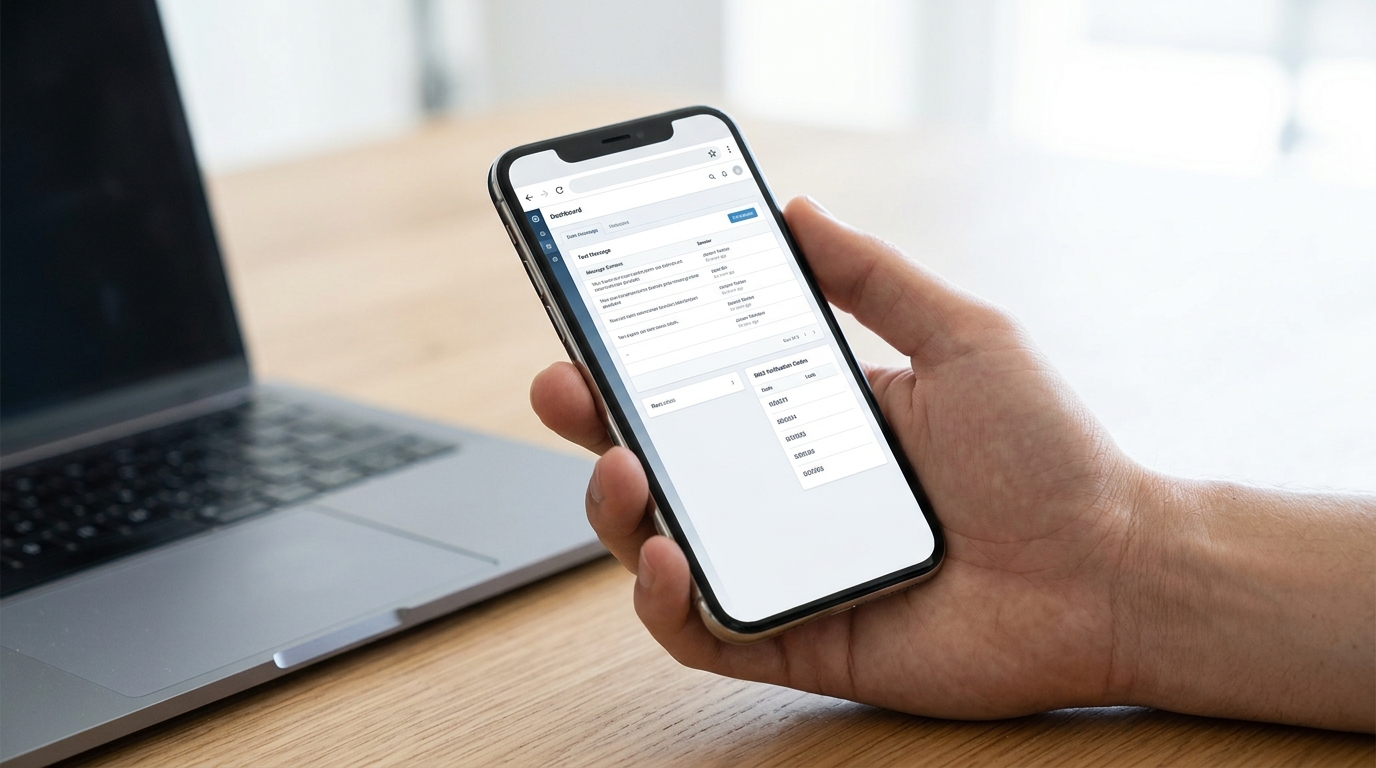
You simply open your dashboard and read the SMS.
No physical device is required.
Cloud Infrastructure Instead of Hardware
This is the biggest architectural difference.
An eSIM modernizes the SIM card.
A virtual number modernizes the phone number itself.
Everything is managed inside professional telecommunications infrastructure.
Users access their messages through:
web dashboards;
browser interfaces;
cloud platforms;
provider portals.
The phone becomes optional rather than essential.
This flexibility is one reason virtual numbers are widely used by businesses and software teams.
Comparing the Communication Path
Imagine receiving a verification code from Google.
With an eSIM, the process looks like this:
Google sends the SMS.
The message travels through telecommunications networks.
Your mobile carrier delivers it.
Your smartphone receives it.
You open your Messages app.
With a virtual number, the process is different.
Google sends the SMS.
The telecommunications network routes the message.
The provider's cloud platform receives it.
The verification code appears inside your online dashboard.
No smartphone needs to receive the message directly.
Mobile Connectivity vs Cloud Communication
This distinction explains why people often confuse the two technologies.
Both involve phone numbers.
Both may receive SMS.
Both operate through telecommunications networks.
However, their objectives are different.
eSIM is primarily about mobile connectivity.
Virtual numbers are primarily about cloud-based communication management.
The technologies complement each other rather than replacing one another.
Why Businesses Often Use Both
Many companies actually combine both technologies.
For example, a sales employee may use an eSIM-enabled smartphone while traveling internationally.
Meanwhile, the company's customer support numbers are managed through virtual number infrastructure.
The employee benefits from reliable mobile connectivity.
The organization benefits from centralized communication management.
Each technology solves a different operational challenge.
How SMS Verification Fits In
SMS verification provides another useful comparison.
Suppose you're creating an account on Telegram.
If you use an eSIM, the verification code arrives directly on your smartphone.
If you use a virtual number, the code appears inside the provider's dashboard.
The verification process is similar from the platform's perspective.
The difference lies in how the message is ultimately delivered to you.
Device Independence
One of the biggest strengths of virtual numbers is device independence.
Because messages are managed through cloud infrastructure, access is not necessarily tied to one specific smartphone.
This can simplify workflows for:
remote teams;
customer support departments;
software developers;
agencies;
organizations with distributed staff.
Instead of depending on one employee's phone, access can be managed through organizational processes.
Network Dependency
eSIM technology depends entirely on mobile network connectivity.
If your device cannot connect to the carrier, communication may be interrupted.
Virtual numbers depend primarily on the provider's cloud infrastructure and telecommunications routing.
As long as you have internet access to your account, you can usually view incoming verification messages regardless of which device you're using to log in.
This difference becomes especially valuable in organizations where account access must continue even when employees change devices.
International Flexibility
Both technologies support international users, but in different ways.
eSIM simplifies international travel.
Instead of purchasing a local SIM card after arriving in another country, you can activate a new carrier profile digitally.
Virtual numbers simplify international communication.
Instead of opening mobile contracts in multiple countries, businesses can obtain numbers from different regions through one centralized platform.
The objective is different, even though both technologies reduce geographical barriers.
Security Considerations
Security also differs.
With eSIM, protecting the device becomes especially important because the mobile subscription resides there.
With virtual numbers, organizations focus more on securing access to the provider's dashboard through strong authentication, account permissions, and administrative controls.
Neither approach is inherently more secure.
They simply require different security practices.
Common Misconception
Many users believe that eSIM technology automatically provides cloud-based flexibility.
It does not.
An eSIM still functions as a traditional mobile subscription installed on one physical device.
Virtual numbers remove the dependency on that single device by managing communication through cloud infrastructure instead.
Understanding this distinction eliminates much of the confusion surrounding both technologies.
Expert Tip
Instead of comparing features one by one, compare the primary objective of each technology.
If your priority is mobile connectivity, voice calls, and mobile data, eSIM is usually the appropriate solution.
If your priority is account verification, communication management, privacy, or scalable business operations, virtual numbers often provide much greater flexibility.
The technologies are most powerful when used for the tasks they were designed to perform.
Key Takeaways
Although eSIM and virtual phone numbers both involve telephone numbers, they operate very differently.
An eSIM stores your mobile subscription digitally inside your device while continuing to rely on traditional carrier infrastructure.
A virtual phone number places the phone number itself inside cloud-based telecommunications infrastructure, allowing messages to be managed independently of any single smartphone.
Understanding this architectural difference makes it much easier to decide which technology best fits your personal or business requirements.
Continue Reading
If you'd like to explore cloud-managed phone numbers in more detail, these guides provide additional practical insights:
Virtual Phone Numbers Explained: Everything You Need to Know in 2026
https://sms-rooms.com/blog/virtual-phone-numbers-explained-everything-you-need-to-know-in-2026
Temporary vs Rental Virtual Numbers: Which Should You Choose in 2026?
https://sms-rooms.com/blog/temporary-vs-rental-virtual-numbers-which-should-you-choose-in-2026
Why SMS Verification Codes Don't Arrive: 25 Common Reasons and How to Fix Them
https://sms-rooms.com/blog/why-sms-verification-codes-don-t-arrive
These articles explain how cloud-based virtual numbers work, how to choose the right type of number, and how to improve verification reliability across today's most popular online platforms.
Virtual Numbers vs eSIM: Which One Is Better?
After learning how both technologies work, it's natural to ask a simple question:
Which one should you choose?
The honest answer is that neither technology is universally better.
They were designed for different purposes.
Comparing them directly is a little like comparing cloud storage with an external hard drive.
Both help you store information, but they solve different problems and are often used together.
The same principle applies to eSIMs and virtual phone numbers.
The right choice depends entirely on what you're trying to accomplish.
When an eSIM Is the Better Choice
An eSIM is primarily designed to improve mobile connectivity.
If your goal is to use your smartphone normally while eliminating the inconvenience of physical SIM cards, an eSIM is an excellent solution.
For many users, it feels almost identical to using a traditional SIM card.
The only noticeable difference is that activation happens digitally.
An eSIM is particularly useful when you need:
mobile data;
voice calls;
regular SMS messaging;
carrier flexibility;
fast network switching;
reliable mobile connectivity.
Because everything operates through your smartphone, the experience remains familiar while becoming much more convenient.
International Travel
One of the strongest advantages of eSIM technology appears during international travel.
Instead of searching for a local SIM card after arriving in another country, travelers can simply activate a local carrier profile before departure or immediately after landing.
This provides several practical benefits.
You avoid roaming charges.
You maintain internet access immediately after arrival.
You no longer need to remove your primary SIM card.
Many travelers even keep multiple eSIM profiles on one device and switch between them whenever necessary.
For frequent international travel, this convenience is difficult to match.
Everyday Mobile Communication
If your primary goal is to replace your existing mobile subscription, an eSIM is usually the most appropriate option.
You continue using your smartphone exactly as before.
You can:
make calls;
receive calls;
send text messages;
browse the internet;
use navigation;
stream media;
access mobile applications.
Nothing about your daily communication habits changes significantly.
The technology simply removes the physical SIM card.
When Virtual Numbers Are the Better Choice
Virtual phone numbers solve a completely different set of challenges.
Instead of focusing on mobile connectivity, they focus on communication management.
This becomes especially valuable when you need to organize multiple accounts or separate different digital identities.
Virtual numbers work particularly well for:
account verification;
business operations;
software testing;
customer support;
project management;
international expansion;
online privacy.
These are situations where flexibility matters more than traditional mobile service.
Managing Multiple Online Accounts
Suppose your business manages accounts for:
Telegram;
WhatsApp;
Google;
Facebook;
TikTok;
Microsoft.
Using one personal phone number for every account quickly becomes difficult.
Virtual numbers make organization significantly easier.
Different numbers can be assigned to different departments, projects, or regions.
Instead of depending on one employee's smartphone, account ownership becomes part of the company's operational structure.
Software Development
Development teams often need to create temporary environments for testing.
These may include:
new user registration;
SMS authentication;
password recovery;
account onboarding;
security testing.
Using physical SIM cards for every test quickly becomes inefficient.
Virtual numbers simplify these workflows while allowing developers to repeat tests consistently across multiple environments.
Customer Support
Customer support departments frequently manage communication across different products, languages, and regions.
Virtual numbers allow organizations to organize these communication channels more effectively.
For example:
One number may support English-speaking customers.
Another may serve German-speaking users.
A third may be dedicated to enterprise clients.
Because the numbers are managed centrally, staffing changes become much easier to handle.
Business Scalability
As businesses grow, communication becomes increasingly complex.
Managing ten phone numbers is relatively straightforward.
Managing hundreds becomes much more challenging.
Virtual number platforms are designed specifically for this type of growth.
Additional numbers can usually be activated within minutes.
Organizations do not need to purchase additional smartphones or maintain large inventories of physical SIM cards.
This scalability explains why virtual numbers have become so popular among digital businesses.
Privacy Considerations
Privacy represents another important difference.
When using an eSIM, your mobile subscription remains associated with your personal device.
With virtual numbers, users often separate different aspects of their digital lives.
Examples include:
personal registrations;
work accounts;
temporary projects;
public-facing activities;
software testing.
This separation makes digital identities easier to manage while reducing dependence on one personal phone number.
Long-Term Account Management
Many users focus only on creating an account.
Businesses think differently.
They ask:
How will we manage this account next year?
Who will own it?
How will password recovery work?
What happens if an employee leaves?
Virtual numbers simplify long-term administration because organizations can manage communication independently from individual devices.
This becomes increasingly valuable as businesses expand.
Situations Where Both Technologies Work Together
One of the biggest misconceptions is that choosing an eSIM means you no longer need virtual numbers—or vice versa.
In reality, many professionals use both.
Imagine an international sales manager.
Their smartphone uses an eSIM to maintain affordable mobile connectivity while traveling.
Meanwhile, the company manages customer support numbers through a virtual number platform.
Each technology performs the task it was designed for.
Neither replaces the other.
Together, they create a much more flexible communication environment.
Which Technology Is Better for SMS Verification?
For ordinary personal accounts, both technologies can receive SMS messages.
However, their practical advantages differ.
An eSIM works well when verification is tied to your everyday mobile subscription.
Virtual numbers become especially useful when you need:
temporary verification;
multiple accounts;
organized account management;
business workflows;
international projects.
This flexibility explains why virtual numbers are widely used across modern verification platforms.
Common Mistake
Many users choose a technology based on advertising rather than actual requirements.
Someone looking for affordable mobile internet may purchase a virtual number and discover that it does not replace a mobile data plan.
Another user needing dozens of verification numbers may purchase multiple eSIM subscriptions when virtual numbers would provide a much more efficient solution.
Understanding your objective first usually prevents these mistakes.
Expert Tip
Before comparing prices, compare workflows.
Ask yourself:
Do I need internet access while traveling?
Do I need a permanent mobile subscription?
Am I managing multiple online accounts?
Will several people require access?
Will future verification be important?
Your answers will usually make the correct technology obvious.
Key Takeaways
eSIM technology excels at mobile connectivity, international travel, and replacing traditional SIM cards.
Virtual phone numbers excel at account verification, communication management, software development, customer support, privacy, and scalable business operations.
Rather than competing technologies, they solve different problems and often complement each other.
Choosing the right solution begins with understanding your own objectives rather than searching for a single technology that attempts to do everything.
Continue Reading
If you'd like to explore virtual phone numbers in greater depth, these guides provide additional practical recommendations:
Virtual Phone Numbers Explained: Everything You Need to Know in 2026
https://sms-rooms.com/blog/virtual-phone-numbers-explained-everything-you-need-to-know-in-2026
Temporary vs Rental Virtual Numbers: Which Should You Choose in 2026?
https://sms-rooms.com/blog/temporary-vs-rental-virtual-numbers-which-should-you-choose-in-2026
Best SMS Verification Services in 2026
https://sms-rooms.com/blog/best-sms-services-2026
Why SMS Verification Codes Don't Arrive: 25 Common Reasons and How to Fix Them
https://sms-rooms.com/blog/why-sms-verification-codes-don-t-arrive
These articles explain how to choose the right type of virtual number, improve verification success, and build an efficient strategy for both personal and business use.
Real-World Scenarios: When Should You Choose an eSIM or a Virtual Number?
Understanding the technical differences between eSIM technology and virtual phone numbers is useful.
Applying that knowledge in real life is even more valuable.
Most people don't choose between these technologies because they're interested in telecommunications.
They choose because they need to solve a specific problem.
Perhaps you're traveling abroad.
Maybe you're launching a startup.
Perhaps you're creating multiple online accounts or expanding into international markets.
The best solution depends on the situation rather than the technology itself.
Let's examine some of the most common scenarios.
Scenario 1: International Travel
Imagine you're flying from Germany to Japan for two weeks.
Your priorities are simple.
You need:
mobile internet;
navigation;
messaging;
ride-sharing apps;
local phone service.
An eSIM is usually the ideal solution.
Instead of searching for a local SIM card after landing, you activate a local carrier profile before your trip or immediately after arrival.
Within minutes, your phone connects to the local mobile network.
You continue using your favorite applications while avoiding expensive international roaming charges.
A virtual phone number, on its own, would not replace your mobile internet connection.
It serves a different purpose.
For travelers, eSIM technology is generally the better choice.
Scenario 2: Creating Online Accounts
Now imagine you're registering accounts on:
Telegram;
WhatsApp;
Google;
Facebook;
TikTok.
Your goal isn't mobile connectivity.
You simply need to complete phone verification.
This is where virtual numbers become particularly useful.
Instead of relying on your personal mobile subscription, you can use a virtual number designed for account verification.
For temporary registrations or project-based work, this often provides greater flexibility while helping separate personal and professional identities.
Scenario 3: Running a Small Business
Small businesses frequently manage several online services at once.
For example:
Google Workspace;
customer support;
WhatsApp Business;
Telegram;
advertising platforms;
cloud services.
The owner may personally use an eSIM-enabled smartphone for everyday communication.
Meanwhile, customer-facing accounts are managed using virtual numbers.
This creates a much more organized communication structure.
Personal devices remain separate from company accounts.
Business continuity also improves because important accounts are not permanently tied to one employee's phone.
Scenario 4: Managing a Growing Team
As businesses expand, communication becomes more complex.
A company with twenty employees may need separate numbers for:
sales;
support;
finance;
marketing;
regional offices.
Purchasing and maintaining physical devices for every communication channel quickly becomes inefficient.
Virtual numbers allow organizations to centralize communication while assigning access according to employee roles rather than device ownership.
This greatly simplifies administration.
Scenario 5: Software Development
Development teams often create temporary accounts while testing applications.
Examples include:
registration workflows;
login systems;
password recovery;
SMS authentication;
API integrations.
Using physical mobile subscriptions for every test would create unnecessary complexity.
Virtual numbers provide developers with flexible testing environments that can be repeated consistently across different projects.
Meanwhile, developers themselves may continue using eSIM-enabled smartphones for everyday communication.
Again, the two technologies complement one another.
Scenario 6: Remote Work
Remote work has changed how organizations communicate.
Employees may work from different cities—or even different continents.
An eSIM helps remote professionals stay connected while traveling between countries.
Virtual numbers help organizations manage customer communication independently of employee locations.
For distributed teams, combining both technologies often provides the greatest flexibility.
Scenario 7: International Expansion
Suppose your company begins serving customers in five different countries.
You need local communication channels that customers recognize and trust.
Virtual numbers allow businesses to establish phone numbers in multiple regions without opening physical offices or signing mobile contracts in every market.
At the same time, traveling employees may rely on eSIM profiles to stay connected while visiting those countries.
Each technology supports a different part of the international expansion process.
Scenario 8: Digital Marketing
Marketing agencies frequently manage accounts for multiple clients.
These accounts may include:
Facebook;
Instagram;
TikTok;
Google;
LinkedIn;
YouTube.
Keeping every account tied to one employee's personal phone quickly becomes risky.
Virtual numbers provide better organization while making it easier to transfer account ownership when projects change.
This is one reason many agencies include virtual numbers as part of their standard operational workflow.
Scenario 9: Protecting Personal Privacy
Many users simply want greater control over how their personal phone number is shared online.
Perhaps you're signing up for a new service but don't want your primary mobile number associated with another account.
A virtual number allows you to separate:
personal communication;
work-related registrations;
experimental projects;
temporary services.
Your eSIM continues supporting everyday mobile communication.
The virtual number handles specific online registrations.
This separation creates a cleaner digital identity.
Scenario 10: Enterprise Operations
Large organizations often combine both technologies across different departments.
Employees use eSIM-enabled smartphones for daily communication.
Customer support teams operate through virtual numbers.
Developers use temporary verification numbers.
Regional offices maintain dedicated business numbers.
Executives travel internationally using multiple eSIM carrier profiles.
Rather than selecting one technology for the entire organization, enterprises typically build communication strategies that combine both.
Can You Use Both Together?
Absolutely.
In fact, many professionals already do.
Consider an entrepreneur who travels frequently.
Their smartphone uses an eSIM for affordable mobile connectivity in different countries.
Their business operates customer support through virtual numbers.
Marketing accounts use separate verification numbers.
Software developers maintain dedicated testing environments.
Nothing about these technologies conflicts.
They simply solve different operational challenges.
Choosing Based on Your Goal
Instead of asking:
"Which technology is better?"
A more useful question is:
"What problem am I trying to solve?"
If your goal is replacing a traditional mobile subscription, choose an eSIM.
If your goal is managing online accounts, improving privacy, organizing business communication, or simplifying verification, virtual numbers usually provide greater flexibility.
Many users eventually discover that the most effective solution is using both where each delivers the greatest value.
Common Mistake
One of the biggest mistakes is assuming that every communication challenge requires only one solution.
Organizations that rely exclusively on mobile subscriptions often struggle with account management.
Organizations that expect virtual numbers to replace everyday mobile connectivity may also become frustrated.
Understanding the strengths of each technology leads to much better long-term decisions.
Expert Tip
When evaluating communication technology, start by listing your actual requirements.
For example:
Do you need mobile internet?
Will you travel internationally?
Are you managing multiple online accounts?
Will several employees require access?
Is long-term account recovery important?
These practical questions almost always produce a clearer answer than comparing technical specifications alone.
Key Takeaways
Real-world communication rarely depends on one technology.
eSIM excels at keeping people connected through modern mobile networks, especially while traveling.
Virtual phone numbers excel at organizing digital identities, supporting online verification, simplifying business communication, and managing large numbers of online accounts.
For many professionals and businesses, the most efficient approach is not choosing between them—but understanding how each technology contributes to a flexible, scalable communication strategy.
Continue Reading
If you'd like to learn more about virtual numbers and SMS verification, these guides provide additional practical advice:
Virtual Phone Numbers Explained: Everything You Need to Know in 2026
https://sms-rooms.com/blog/virtual-phone-numbers-explained-everything-you-need-to-know-in-2026
Best SMS Verification Services in 2026
https://sms-rooms.com/blog/best-sms-services-2026
Best Countries for SMS Verification in 2026
https://sms-rooms.com/blog/best-countries-for-sms-verification-2026
Temporary vs Rental Virtual Numbers: Which Should You Choose in 2026?
https://sms-rooms.com/blog/temporary-vs-rental-virtual-numbers-which-should-you-choose-in-2026
Why SMS Verification Codes Don't Arrive: 25 Common Reasons and How to Fix Them
https://sms-rooms.com/blog/why-sms-verification-codes-don-t-arrive
These resources explain how to build a reliable verification strategy, choose the right provider, and make the most of modern communication technologies.
Comparing Virtual Numbers and eSIM in Everyday Life
By this point, one thing should already be clear.
Virtual phone numbers and eSIM technology are not direct competitors.
They solve different problems, operate differently, and are often used together.
Even so, people still ask:
"Which one should I choose?"
The answer depends entirely on your priorities.
Let's compare both technologies across the situations that matter most in everyday life.
Mobile Internet
If your primary goal is staying connected while using maps, messaging applications, email, video calls, and web browsing, an eSIM is the clear choice.
An eSIM functions as a mobile subscription.
Your device connects directly to a carrier's network and receives mobile data exactly as it would with a traditional SIM card.
Virtual numbers are not designed to replace mobile internet.
They focus on communication management rather than internet connectivity.
If reliable mobile data is your priority, eSIM technology is the appropriate solution.
Phone Calls
Traditional voice communication is another area where eSIM has an advantage.
Most eSIM plans support:
voice calls;
incoming calls;
outgoing calls;
SMS messaging;
mobile data.
Virtual numbers vary considerably.
Some providers support voice services.
Others focus exclusively on SMS verification.
If regular voice communication is essential, verify the provider's capabilities before choosing a virtual number.
SMS Verification
This is one area where virtual numbers have become particularly popular.
People creating accounts on online platforms often need only one thing:
A verification code.
Virtual numbers are designed specifically for workflows like:
account registration;
authentication;
password recovery;
software testing;
project deployment.
An eSIM can certainly receive verification messages.
However, using your everyday mobile subscription for every online registration is not always the most practical approach, especially for businesses or users managing multiple projects.
Managing Multiple Accounts
Suppose you operate:
several Google accounts;
multiple Telegram communities;
different WhatsApp Business profiles;
regional Facebook pages.
Managing all of them through one personal mobile subscription quickly becomes difficult.
Virtual numbers provide much greater organizational flexibility.
Different accounts can use different numbers.
Ownership becomes easier to document.
Future administration becomes significantly simpler.
nternational Business
Companies serving multiple countries have communication requirements that differ from those of individual users.
A global organization may need:
local customer support;
regional registrations;
country-specific communication channels.
Virtual numbers simplify these tasks because organizations can obtain numbers from different countries through one centralized platform.
An eSIM, by comparison, helps individual employees stay connected while traveling between those countries.
Again, both technologies contribute to international operations—but in different ways.
Privacy
Privacy has become increasingly important as more services require phone verification.
Many people prefer not to connect every online account to their personal mobile number.
Virtual numbers help create separation between:
personal communication;
professional activities;
temporary registrations;
public-facing projects.
An eSIM improves convenience but does not fundamentally change how your personal phone number is used across online services.
For users focused on reducing unnecessary exposure of their primary number, virtual numbers often provide greater flexibility.
Remote Teams
Remote work introduces new communication challenges.
Employees work from different cities, countries, and time zones.
Using one employee's personal mobile number for company accounts creates unnecessary operational risk.
Virtual numbers allow organizations to centralize communication independently of employee devices.
Meanwhile, remote employees benefit from eSIM technology by maintaining reliable mobile connectivity wherever they work.
Both technologies support remote work from different perspectives.
Software Development
Development teams frequently create temporary environments while testing software.
Authentication systems often require repeated account creation.
Virtual numbers simplify this process because developers can manage verification separately from their personal devices.
An eSIM provides little additional benefit for automated testing workflows beyond normal mobile connectivity.
For development environments, virtual numbers are usually the more practical solution.
Digital Marketing
Marketing agencies often manage dozens—or even hundreds—of online accounts across different platforms.
Campaigns may include:
Google Ads;
Facebook;
TikTok;
LinkedIn;
YouTube;
regional social networks.
Virtual numbers allow agencies to organize these accounts according to clients, campaigns, or geographic markets.
This structured approach reduces administrative complexity while improving long-term account management.
Long-Term Business Operations
As organizations grow, account management becomes increasingly important.
Businesses rarely ask only:
"Can we receive today's verification code?"
Instead, they ask:
Who owns the account?
Who can recover access?
What happens if an employee leaves?
How do we transfer responsibility?
Virtual numbers support these organizational processes by separating account ownership from individual mobile devices.
Cost Considerations
Price is often the first comparison users make.
However, focusing only on the initial purchase price can be misleading.
An inexpensive solution that creates administrative difficulties later may ultimately cost more than a slightly more expensive solution designed for long-term management.
Instead of asking:
"Which option costs less today?"
Ask:
"Which option supports my workflow most efficiently?"
That question usually produces a better decision.
Flexibility
Flexibility is one of the biggest differences between these technologies.
An eSIM modernizes the traditional mobile subscription.
A virtual number modernizes how organizations manage communication.
As business requirements become more complex, cloud-managed communication often provides greater scalability.
At the same time, everyday mobile communication continues to depend heavily on technologies such as eSIM.
The most adaptable organizations recognize the strengths of both.
Which Technology Fits Different Users?
Different users naturally prioritize different outcomes.
A traveler usually values reliable mobile data and simple carrier switching.
A startup values organized account verification.
A software developer values repeatable testing environments.
A multinational company values centralized communication management.
Choosing the right technology begins with understanding these priorities rather than searching for one universal solution.
Can They Replace Each Other?
This question appears frequently.
The short answer is no.
An eSIM cannot replace a cloud-managed communication platform.
Likewise, a virtual number is not designed to replace a mobile subscription with voice and mobile data services.
Each technology fills a different role.
Trying to force one technology to perform the work of the other usually leads to disappointment.
Why Many Professionals Use Both
Some of the most efficient communication strategies combine both technologies.
For example:
A consultant may use an eSIM while traveling internationally.
The same consultant manages client registrations through virtual numbers.
A software company equips employees with eSIM-enabled devices while maintaining customer support numbers through virtual communication platforms.
A global marketing agency uses virtual numbers for regional campaigns while employees rely on eSIM profiles for business travel.
These examples demonstrate that the technologies are complementary rather than competitive.
Common Mistake
Many buyers start by asking:
"Which technology is newer?"
A better question is:
"Which technology solves my problem?"
Choosing based on marketing trends instead of practical requirements often results in unnecessary expense and operational complexity.
Technology should adapt to your workflow—not the other way around.
Expert Tip
Whenever you're evaluating communication technology, think beyond today's immediate task.
Consider how you'll manage the account six months from now.
Will the project grow?
Will additional people need access?
Will international expansion become necessary?
Planning ahead usually leads to a much more effective communication strategy.
Key Takeaways
eSIM and virtual phone numbers are designed for different aspects of modern communication.
eSIM improves mobile connectivity by replacing the traditional SIM card with a digital carrier profile.
Virtual phone numbers improve account management, verification, privacy, and organizational flexibility through cloud-based infrastructure.
Rather than asking which technology is better, focus on which technology best supports your specific goals.
For many professionals and businesses, the answer is not choosing one over the other—but using both together in the situations where each delivers the greatest value.
Continue Reading
If you'd like to learn more about virtual phone numbers and modern verification strategies, these resources provide additional guidance:
Virtual Phone Numbers Explained: Everything You Need to Know in 2026
https://sms-rooms.com/blog/virtual-phone-numbers-explained-everything-you-need-to-know-in-2026
Temporary vs Rental Virtual Numbers: Which Should You Choose in 2026?
https://sms-rooms.com/blog/temporary-vs-rental-virtual-numbers-which-should-you-choose-in-2026
Best SMS Verification Services in 2026
https://sms-rooms.com/blog/best-sms-services-2026
Best Countries for SMS Verification in 2026
https://sms-rooms.com/blog/best-countries-for-sms-verification-2026
Why SMS Verification Codes Don't Arrive: 25 Common Reasons and How to Fix Them
https://sms-rooms.com/blog/why-sms-verification-codes-don-t-arrive
These articles explain how to choose the right virtual number, optimize SMS verification, and build a scalable communication strategy for both personal and business use.
Frequently Asked Questions About Virtual Numbers and eSIM
Although virtual phone numbers and eSIM technology are becoming more common every year, many users still have questions about how they work and when they should be used.
Below are answers to some of the most frequently asked questions.
Are Virtual Phone Numbers and eSIM the Same Thing?
No.
They solve different problems.
An eSIM is a digital version of a traditional SIM card that allows your smartphone to connect to a mobile carrier without using a physical SIM.
A virtual phone number is a cloud-managed telephone number that can be used for SMS verification, business communication, customer support, and many other purposes.
Although both involve phone numbers, they operate differently.
Can I Use a Virtual Number Without a Smartphone?
Yes.
One of the biggest advantages of virtual numbers is that they are not tied to a specific mobile device.
Depending on the provider, you can access incoming SMS messages through a web dashboard or online account from almost any internet-connected device.
Do I Need an eSIM to Use a Virtual Number?
No.
These technologies are completely independent.
You can use a virtual phone number without owning an eSIM-compatible device.
Likewise, you can use an eSIM without ever using a virtual number.
Can I Use Both Together?
Absolutely.
Many professionals do.
For example:
an eSIM provides mobile connectivity while traveling;
a virtual number manages business verification;
another virtual number supports customer communication.
Each technology performs the task it was designed for.
Which Option Is Better for Travel?
For most travelers, eSIM is the better solution.
It allows you to activate local carrier plans digitally without replacing physical SIM cards.
This makes it easier to access mobile data, calls, and SMS while abroad.
Virtual numbers remain useful for account verification and business communication but are not intended to replace mobile connectivity.
Which Option Is Better for SMS Verification?
If your goal is verifying online accounts, virtual numbers are usually the more flexible solution.
They are commonly used for:
Telegram;
WhatsApp;
Google;
Facebook;
TikTok;
Microsoft;
Amazon;
hundreds of other online platforms.
Businesses and developers also benefit from being able to organize multiple verification workflows independently of personal mobile subscriptions.
Which Option Is Better for Business?
Businesses often benefit from using both technologies.
Employees may rely on eSIM-enabled smartphones for everyday communication.
At the same time, organizations use virtual numbers for:
customer support;
account verification;
regional operations;
project management;
software testing.
Combining both technologies usually creates the most flexible communication environment.
Can Virtual Numbers Receive Calls?
Some can.
Others support SMS messages only.
Available features depend on the provider and the specific number.
Always review the service description before choosing a number for voice communication.
Are Virtual Numbers Secure?
Professional providers implement security measures such as encrypted communication, protected customer dashboards, access controls, and infrastructure monitoring.
Users should also protect their own accounts with strong passwords and, where available, multi-factor authentication.
Are eSIMs More Secure Than Physical SIM Cards?
eSIM technology removes the need to physically swap SIM cards, which can reduce certain risks associated with lost or damaged hardware.
However, both eSIMs and traditional SIM cards ultimately depend on the security practices of the carrier, the device, and the user.
Strong account protection remains essential regardless of the technology you choose.
Can I Use Virtual Numbers Internationally?
Yes.
This is one of their greatest strengths.
Many providers offer virtual numbers from multiple countries, allowing businesses and individuals to establish local communication channels without opening offices or purchasing physical SIM cards in every market.
Are Virtual Numbers Only for Businesses?
No.
Many individuals use virtual numbers for legitimate personal purposes, including:
protecting privacy;
separating work and personal accounts;
software testing;
temporary registrations;
online services.
Business users simply tend to benefit from them on a larger scale.
Will eSIM Replace Physical SIM Cards Completely?
The adoption of eSIM technology continues to grow rapidly, and many modern smartphones already support it.
However, physical SIM cards remain widely used around the world.
For the foreseeable future, both technologies are likely to coexist, giving users the flexibility to choose the option that best fits their needs.
Can One Virtual Number Replace All My Phone Numbers?
Usually not.
Different accounts often have different requirements.
Some projects need temporary verification.
Others require long-term access or dedicated ownership.
Using the appropriate type of virtual number for each situation generally leads to better organization and easier account management.
Best Practices
Choosing the right communication technology is only part of the process.
Using it effectively is equally important.
Define Your Objective First
Before purchasing either an eSIM or a virtual number, ask yourself what you're trying to achieve.
Do you need:
mobile internet?
voice communication?
account verification?
international expansion?
customer support?
software testing?
Clear objectives make technology decisions much easier.
Think Beyond Today's Registration
Creating an account is only the beginning.
Consider how you'll manage that account in the future.
Who will have access?
How will password recovery work?
Will additional verification be required?
Planning ahead often prevents unnecessary complications later.
Choose Reliable Providers
Whether you're selecting an eSIM carrier or a virtual number provider, reliability matters.
Look for companies that offer:
transparent pricing;
responsive support;
stable infrastructure;
strong reputation;
broad coverage.
A dependable provider usually saves far more time than choosing the cheapest option.
Separate Personal and Professional Accounts
Whenever practical, avoid connecting important business accounts to personal mobile subscriptions.
Using dedicated virtual numbers for business communication makes account ownership clearer and simplifies employee transitions.
Review Your Communication Strategy Regularly
Technology evolves quickly.
The communication strategy that worked two years ago may no longer be the most efficient today.
Review your workflows periodically and adjust them as your business or personal needs change.
Expert Recommendations
After examining both technologies, one conclusion becomes clear.
eSIM and virtual phone numbers are not competing products.
They are complementary tools designed for different parts of the modern digital ecosystem.
eSIM improves how devices connect to mobile networks.
Virtual numbers improve how people and organizations manage communication, verification, and digital identities.
The most successful businesses rarely choose only one.
Instead, they build flexible communication strategies that take advantage of the strengths of both.
Continue Learning
If you'd like to explore these topics in greater detail, the following guides provide practical recommendations for different platforms and verification scenarios.
Virtual Phone Numbers Explained: Everything You Need to Know in 2026
https://sms-rooms.com/blog/virtual-phone-numbers-explained-everything-you-need-to-know-in-2026
Temporary vs Rental Virtual Numbers: Which Should You Choose in 2026?
https://sms-rooms.com/blog/temporary-vs-rental-virtual-numbers-which-should-you-choose-in-2026
Best SMS Verification Services in 2026
https://sms-rooms.com/blog/best-sms-services-2026
Best Countries for SMS Verification in 2026
https://sms-rooms.com/blog/best-countries-for-sms-verification-2026
Best Virtual Numbers for Telegram in 2026
https://sms-rooms.com/blog/best-virtual-numbers-for-telegram-in-2026-complete-guide
Best Virtual Numbers for WhatsApp in 2026
https://sms-rooms.com/blog/best-virtual-numbers-for-whatsapp-in-2026-complete-guide
Google & Gmail Phone Verification in 2026
https://sms-rooms.com/blog/google-gmail-phone-verification-in-2026
Why SMS Verification Codes Don't Arrive: 25 Common Reasons and How to Fix Them
https://sms-rooms.com/blog/why-sms-verification-codes-don-t-arrive
Together, these resources provide a complete understanding of virtual numbers, SMS verification, account security, and modern communication technologies.
Conclusion
Virtual phone numbers and eSIM technology represent two important innovations in modern telecommunications, but they were created to solve different challenges.
An eSIM simplifies mobile connectivity by replacing the traditional SIM card with a digital carrier profile. It is ideal for travelers, remote workers, and anyone who wants greater flexibility when using mobile networks.
A virtual phone number moves communication management into the cloud. It enables efficient SMS verification, organized account management, customer communication, software testing, and scalable business operations without relying on a single physical device.
Throughout this guide, we've explored how both technologies work, where they excel, and how they can be combined to create a more flexible communication strategy.
The most important takeaway is this:
Don't choose the newest technology. Choose the technology that solves your specific problem.
For many individuals, that means using an eSIM for everyday mobile connectivity and a virtual phone number for online verification and account organization.
For businesses, combining both technologies often creates the most scalable and resilient communication infrastructure.
Understanding these differences will help you make better decisions, reduce unnecessary costs, and build a communication strategy that supports both your current needs and your future growth.
About the Author
Daniel Carter
Daniel Carter is a technology writer specializing in telecommunications, virtual phone numbers, eSIM technology, SMS verification, digital identity, and online privacy. His work helps businesses, developers, and individual users understand modern communication technologies and implement reliable verification and account management strategies.
Ready to Choose the Right Virtual Number?
Whether you're verifying an online account, managing business communications, or expanding internationally, SMS-ROOMS offers reliable virtual phone numbers across multiple countries with fast SMS delivery and support for hundreds of online services.
👉 Explore Available Virtual Numbers: https://sms-rooms.com/